Curator's Note

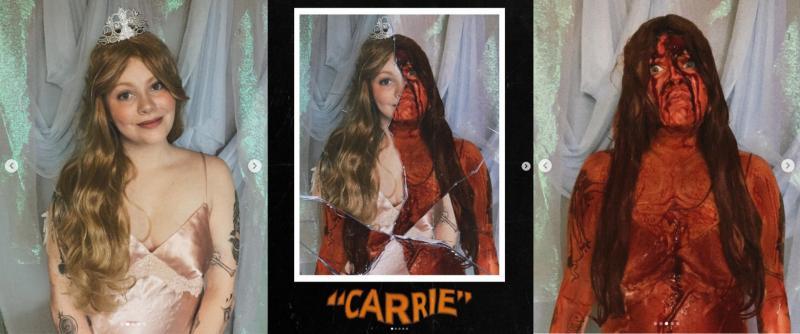
@jodimakescostumes (she/her) as Carrie. Screenshots taken from Instagram.
Fifty years after its release, Carrie (Brian De Palma, 1976) feels more relevant than ever. Her story, with its pain, loneliness, menstrual monstrosity, and female rage, still speaks to thousands of social media users celebrating the 50th anniversary across platforms. Amid the current rise of heteropessimism in the horror genre, Carrie functions as the perfect place for female identification, but more specifically for femcel-tification. Femcels, the female counterparts of incels, have recently gained traction as an online community. Their online visibility has been eclipsed by the incel community because women are often not allowed to self-identify as involuntary celibates. Unlike incels, femcels do not blame men for their lack of sexual interaction; they blame themselves for failing to meet hegemonic beauty standards. Brian de Palma’s Carrie serves as a tale of awkward femininity and abjection, with a heteropessimistic ending that punishes Carrie’s character for her monstrous tendencies. While rewatching the film, a question arose: is Carrie an incel or a femcel horror film?
In 1992, Carol J. Clover argued that the film adaptation of Carrie, based on Stephen King’s homonymous novel, is a site of male identification for teenage boys. Clover questions King’s approach to this female protagonist and how the author himself identified with Carrie as an othered teenager. At the same time, Carrie represents the fear of 1970s women’s liberation: how feminism gives girls a language for understanding their position as victims, and the anger that can fuel acts of revenge[1]. Viewed through our current perspective and using internet lingo, Clover’s theory of cross-identification would frame Carrie as an incel character. Carrie is involuntarily celibate, and she uses her rage and telekinetic powers to improve her position inside the diegetic world. When her schoolmates pull the ultimate prank on her, she kills them all. While this sounds like an incel solution, Carrie’s powers are amplified by her menstruation. Because of this character’s traits and the film’s reception over the past 50 years, Carrie remains a classic within female horror fandoms.
In her YouTube video “Is Carrie White the Original Femcel?”, Erin Nicolette argues that Carrie fits the femcel label because she is constantly othered for her awkward take on femininity. Her exclusion comes mainly from sexual difference, as she is not able to integrate due to her lack of knowledge about her own female biology. In a looksmaxxing[2] attempt, Carrie tries to improve her femininity with a pink gown and makeup while accepting Tommy Ross’s invitation to the prom to fit in with the other kids. However, this attempt fails, and her classmates put her back in her Othered place, where femcel monstrosity rises, and Carrie executes her final revenge on the High School that constantly bullied her. This prom scene has fueled female horror fandoms for decades, culminating in the convergence culture[3] that we are witnessing on social media platforms. While scrolling through Instagram looking for Carrie fan art or fan work, I came across many female-presenting users who have recreated Carrie’s prom look through cosplay, one of the most feminine forms of fan expression. For example, @jodimakescostumes did her own take on the 1976 movie poster, capturing Carrie White's duality. Her beautiful handmade gown, simple natural makeup, and long hair made Carrie feel like one of the “cool” kids for a night. Through her looksmaxxing process, Carrie is able to fit in, only for a couple of hours. Her other side, the femcel side, represents her menstrual monstrosity, female rage, and the fatal ending that the cosplayer showcased in her own interpretation of the prom scene. Jodi successfully conveyed Carrie’s monstrous femininity through her costuming, fake blood, and facial expressions, translating the film’s affection into a single post.
Even though we never get a non-hegemonic representation of Carrie, she speaks to all of us female horror fans as our first menstrual monster. Her pain, power, and othering have inspired thousands of horror fans worldwide to keep recreating Carrie’s most painful experience and the female revenge she carried out by the end of her prom. While Carrie could be explicitly classified as an incel character for her involuntary celibacy and violent expression of rage, her femininity and exclusion due to menstruation have made her the perfect candidate for femcel audiences to self-identify within the flourishing online wave of heteronihilism[4].
[1] Carol J. Clover, 1992, Men, Women, and Chain Saws: Gender in the Modern Horror Film, Princeton University Press.
[2] According to UrbanDictionary.com Looksmaxxing is “the process of making yourself look better commonly used by incels.”
[3] Henry Jenkins, 2006, Convergence Culture: Where Old and New Media Collide, NYU Press.
[4] Jacob Johanssen and Jilly Boyce Kay, 2024, “From femcels to ‘femcelcore’: Women’s involuntary celibacy and the rise of heteronihilism” European Journal of Cultural Studies.
Add new comment