Curator's Note
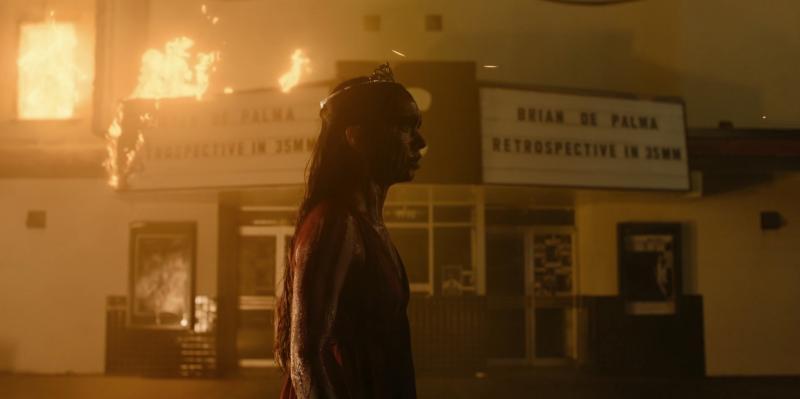
Mike Flanagan’s Carrie (Amazon Prime Video, 2026-) wraps not at prom but at the afterparty. While the mysterious Adelaide (Kate Siegel) presses survivors of the Ewen High School massacre for information on Carrie’s (Summer Howell) whereabouts, the queen herself skips town, riding shotgun with her partner in crime, Emaline (Thalia Dudek). Earlier in the episode, an astrally projected Emaline implores the bloodied and abashed Carrie, “lemme take the wheel,” driving much of the violence thereafter. Here, on the road, she assures her rattled passenger, “I’m escorting you to safety from the monsters on our heels”—Adelaide and company, presumably—“and it is my fucking honor. Who am I? I am your friend. And where are we? That’s the world. That’s what you always wanted, right? And it belongs to you, Carrie. And I know that you feel guilty and we’re going to work on that too, because you didn’t break anything but shackles.” A dawning realization: “It’s my world.” Emaline: “Yeah, it is.” Carrie: “My world.” Emaline: “The whole thing.” Carrie: “It’s my world.” Emaline: “Where you wanna go?” Carrie smiles.
This worldly exchange sets a new course for Carrie—and for Carrie. Just a couple of weeks after the show’s October 7th premiere, it was renewed for a second season, much to the chagrin of some fans, who, in the Adelaide and Emaline shenanigans, detected notes of Flanagan’s Doctor Sleep (his Shining sequel/adaptation from 2019) and hints of Dark Tower (which Flanagan is currently developing for the small screen). On Reddit’s Stephen King sub, csplex wrote that “Carrie (2026) did not stick the landing”: “The first seven episodes were a masterfully crafted, deeply human story about trauma and isolation and so for the final episode to be used a launchpad for ‘The Dark Tower’ … felt completely forced and like a betrayal or abandonment of the narrative they had been building the whole season.” KayTheLedge likewise lamented the “boring shared universe rubbish at the end,” while BagofSmallerBags complained, “I’m honestly just exhausted of watching stuff that feels like an advertisement for another ‘cinematic universe.’” And yet, as some Redditors themselves mused, King’s literary works have long formed a shared world orbiting The Dark Tower’s nexus.
If “Ka is the wheel,” as Dick Halloran (Carl Lumbly) avers at one point in Flanagan’s Doctor Sleep, alluding to The Dark Tower’s fateful machinations, then Carrie is the spoke. It had to be Carrie—King’s first novel and the first committed to screen, in Brian De Palma’s still-sparkling 1976 film of the same name. Improbably, that blockbuster laid the foundation for fifty years of some hundred film and television projects drawn from Uncle Stevie’s oeuvre, enough to inspire their own feature-length documentary (2022’s King on Screen), and enough to cement King’s place as “the most frequently adapted American author since Edgar Allan Poe,” as Thomas Leitch writes in his History of American Literature on Film (372). Carrie is now the most frequently adapted King story since “Children of the Corn” (1977); there’s De Palma’s film, a 1999 sequel, two remakes (1990/2013), and Flanagan’s series.
In Adaptations in the Franchise Era, I argued that the twenty-first century’s formally incorporated franchises like Harry Potter and Lord of the Rings evolved from the twentieth century’s looser aggregates of literary adaptations: Sherlock Holmes, Frankenstein, Austen, Dickens (14-15). In the 2026 Carrie, Flanagan merely formalizes—could we say shackles?—a cinematic world that started spinning in 1976. The closest King’s fans had come to glimpsing that world in toto before was the somewhat more modest Castle Rock (Hulu, 2018-19), which relocated many of the author’s characters to one of his favorite (fictional) Maine settings, the titular Rock; none other than Carrie Prime (Sissy Spacek) played Ruth Deaver, a close associate of famed King protagonist Alan Pangborn (Scott Glenn). When Flanagan, the Emaline to King’s Carrie, hit the road in 2026, he did so with significant prior mileage in the author’s world, having not only doctored Sleep but also having played Gerald’s Game (2017) and having lived The Life of Chuck (2025) in two other well-received King adaptations. He’d also brought over two dozen stories by Poe—King’s runner-up in the adaptation race—under the same roof in The Fall of the House of Usher (Netflix, 2023), a mash-up in the same vein and vicinity as Castle Rock.
All to say that Flanagan has been headed toward Carrie’s final—or finale—horizon for a while. And in looking forward, Flanagan looks back to the origin of King’s cinematic universe. After Carrie and Emaline (or a projection thereof) abscond from the prom, they dance in the middle of a fiery street. When Emaline disappears, Carrie looks around in bewilderment, a theatre marquee briefly visible behind her: “BRIAN DE PALMA RETROSPECTIVE IN 35MM.” Carrie doesn’t inherit the world at the end of season one; as Emaline suggests, it was always hers. Even if only in the rearview, going up in flames, De Palma’s Carrie stands as the eve of the Kingverse, the Kingverse’s Eve.
Add new comment