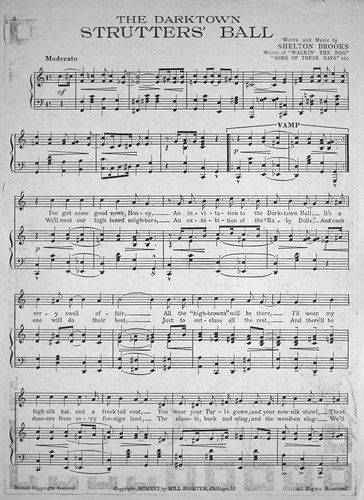
Curator's Note
“It’s worth pointing out that vamp is both a vernacular term for seductress as well as a musical motif common in jazz,” writes Louis Chude-Sokei in a passing parenthetical notation in his book The Sound of Culture: Diaspora and Black Technopoetics. I’d like to pursue this musical undercurrent—one that Chude-Sokei suspends in his discussion of science fiction—into the realm of sultry horror where it might tear out of these brackets.[1]
But right now, we’re following Katharina M. Wilson who points out in “The History of the Word ‘Vampire’” that the word for this creature of horror appears to have blurred historical origins. Amongst the four schools of thought that either pose Turkish, Greek, Hebrew, or Hungarian origins, she concludes: “Paradoxically, although the superstition of vampirism seems to have developed in Eastern Europe, the word ‘vampire’ (for which the Slavic cognate is upir) that is now universally used to describe the phenomenon, seemed to have gained popularity in the West.” She finds that the data in historical records overwhelmingly show the first occurrences of the word “vampire” as a Western concept that refers to Slavic superstitions abroad.[2]
To return to Chude-Sokei’s parenthetical, the vamp is a short looping chord progression or rhythmic figure and, in jazz, it’s typically an improvised foundation that gives a bit of creative freedom to the accompaniment. The vamp can be used as a springboard (before the tune), a tag (following the tune), or as background. The common phrases “vamp” or “vamp till ready” on sheet music indicate the need to bide time through repetition: as an intro or outro, during a costume change, perhaps underneath and in support of another performer’s improvisation.
The jazz vamp appears as its own concept in The German Wikipedia and falls under the Ostinato in the English one. Both suggest something may get lost in translation or go amiss in hosting the term outside its practical and cultural context, much less in its phenomenological form as a material soundscape.[3] What does the vamp do outside its capacity to be used? How is it felt in and known by the body? It sustains the listener’s interest in anticipation of eventual change and increases desire as they remain suspended.
Together, the vamp and the vampire, understood in terms of personal, ensemblic, and geopolitical experiences of desire, call forth certain questions: What does it mean when the loudest, farthest-reaching sounds are posed with clarity regarding phenomena experienced at a distance—and how might a listener grow their desire for sounds that seem repetitive, soft, muffled, or distorted underneath? Given the surge in socialite vampires who take excessive pleasure in the world and one another—in addition to those that hole up in distant castles—what does it mean when audiences desire and take pleasure in the fantasy of their own present annihilation and future transformation, imagining the self as a romantic and eternal victim of sensations generated by a foreign figure? Finally, how might this same desire differently take shape in sound-based practices and image-based practices—and what is the structure of feeling for each?
These are questions I pose to myself (and the IMR readership) as a part of the liquid blackness research on sound design. At present these queries remain a prompt for thought, but I certainly feel them developing as we speak (deep in my typing fingers) and cannot wait to let them loose—or to hear a response to my call—whichever surfaces first.
Notes
[1] Chude-Sokei, Louis. The Sound of Culture: Diaspora and Black Technopoetics. Middletown: Wesleyan University Press. 2016.
[2] Wilson, Katharina M. “The History of the Word ‘Vampire.’” Journal of the History of Ideas 46, no. 4 (1985): 577-583
[3] The fluctuating and oftentimes contradictory comments that, taken together, constitute a blurrier yet also more precise definition in this Drumforum thread are more interesting to me and stand as inspiration for the development of this piece.
Add new comment